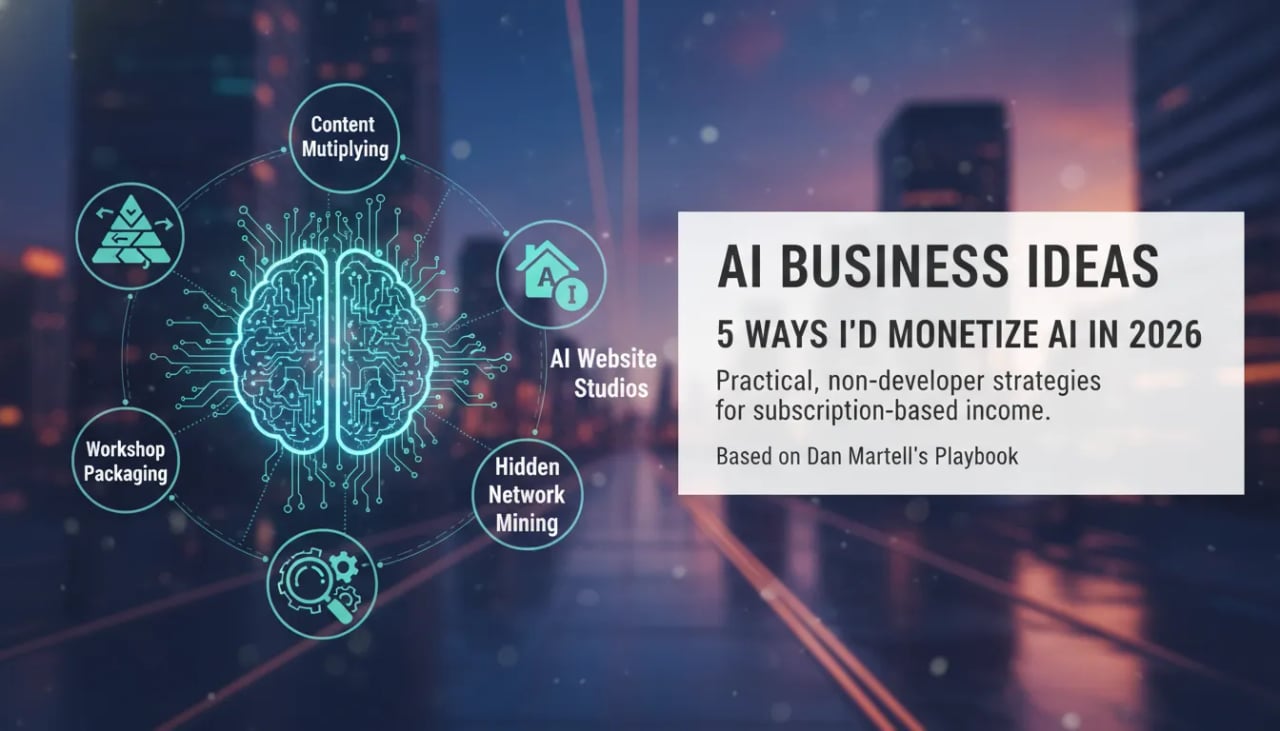

Last week I watched a roomful of smart operators do the same thing I’ve done: nod along to “AI is the future,” then freeze when it’s time to actually set something up. The funny part? The money isn’t in knowing every model update—it’s in making AI feel boringly usable for someone else. This outline borrows from Dan Martell’s five methods and adds my own “human” filter: what I’d actually try first, what I’d avoid, and where the recurring revenue hides.
1) The uncomfortable truth: AI pays for “setup,” not hype
In the AI Business 2026 conversation, I keep hearing “you don’t need to be an expert.” That’s mostly true: you can use Artificial Intelligence to get real output fast. But it’s dangerously false if you think output equals a business. Businesses don’t pay for hype—they pay for setup: the workflow, guardrails, and repeatable results.
Dan Martell claims Martell Ventures launches and scales a new AI company every month, and that their portfolio is on track to be worth $1B in under three years (his claim, not audited results). The part that stuck with me is the focus on prompts as real value:
“Intellectual property of the future is your system prompt.” — Dan Martell
My rule of thumb: repeatable task → offer → AI as Service
When I do Market Trend Analysis on AI Business Ideas, the winners look boring: they turn a repeatable task into an offer, then into AI as Service (AIaaS). If I can document it, measure it, and hand it to someone else, it can become a revenue line.
Repeatable: same inputs, same steps, same output format
Packaged: clear scope, timeline, and “done” definition
Productized: templates, prompts, checklists, and QA
A quick vignette (why prompts aren’t enough)
I tried teaching a friend “better prompts” for lead research. After 20 minutes, they still got messy results. The fix wasn’t another lecture—it was a workflow: input form → prompt library → validation steps → CRM-ready output. That’s what clients buy.
AI is a power tool: nobody pays you to own the drill; they pay you to hang the shelves straight. That’s where Revenue Models like consulting, licensing, and especially subscription-based SaaS (predictable revenue) start to make sense.
2) Personalized GPT ecosystem (Custom AI Development + Subscription Services)
If I wanted a clean, high-ticket Monetization Model in 2026, I’d sell a personalized GPT ecosystem to Target Customers who are overwhelmed founders and CEOs doing $7M–$10M+ a year. They’ve heard of custom GPTs, system prompts, and “AI workflows,” but they’re stuck. The real demand sounds like this:
“Who can I pay to set this up for me?” — Dan Martell
Personal aside: I’d rather build one executive’s AI “home screen” than chase 10 small gigs with unclear scope. This is custom GPT consulting packaged as Custom AI Development and Custom AI Solutions.
The 4-part delivery (what I’d actually ship)
Intake form: collect preferences, workflows, tone, goals, and key context.
Build: create a master prompt, system prompts, custom GPTs, and project folders that match their real work.
SOP/playbook: load the docs into ChatGPT and have it draft a simple SOP for how to use the projects, prompts, and instructions.
Install: with proper access, I label and set everything up inside their account so it’s easy to find and use.
Where recurring revenue lives: Subscription Services
I’d charge a setup fee, then Subscription Based maintenance (think SaaS Pricing) for updates every couple months, new projects, and prompt tuning. Subscription-based SaaS models are popular because they create predictable revenue, and AI services can blend consulting + “AI as a Service.”
Platform + trust
This works on ChatGPT or Gemini. I’d also use a lightweight security checklist: least-privilege access, written permission, and no sensitive data handling unless explicitly approved.
3) Content multiplying: the repurposing offer I’d productize
I used to think content repurposing was “lazy.” Then I realized it’s just distribution with respect for what already worked—and it’s one of the lowest-barrier Revenue Models I’d run in 2026 using AI Marketing Tools. With generative AI projected to reach $1.3T by 2032, this kind of Content Creation service will only get easier to deliver.
Target Customers + pre-qualifier (Market Research)
My Market Research filter is simple: I only pitch brands with a long-form library—podcasts, webinars, or YouTube. If they have no backlog, a content repurposing agency can’t multiply anything. I look for companies that underuse TikTok, Snapchat, Instagram, and have weak short-form and shallow LinkedIn depth (easy Customer Acquisition wins).
My productized pipeline (repeatable deliverables)
Find winners: pick top performers by views/engagement.
Transcribe: clean transcript for accuracy.
Extract punchy segments: pull the strongest moments.
Reformat by platform: clips, carousels, memorable tweets, and LinkedIn posts.
The PSL trick to keep it human
“If you have a long piece of content, just ask ChatGPT to package it into a PSL framework—point, story, lesson.” — Dan Martell
From one long-form piece, I can usually get 5–6 PSLs. Quality bar: I rewrite hooks, preserve context, and avoid misquotes—no lazy clipping.
Monetization Model
I’d sell a monthly retainer (subscription services): e.g., 3 clips + 2 carousels + 5 tweets per week, with an optional lead-based revenue share as a bonus.

4) AI website studio: no-code delivery with Lovable + Framer
The pitch is simple: deliver pixel-perfect, responsive sites without code. I’m not selling “design genius”—I’m selling speed, tight iteration, and a clear path from Minimum Viable Product to a full site. As Dan Martell puts it:
“Tools like Lovable or Framer.com make it possible to spin up sites in literally seconds with no coding experience.” — Dan Martell
I’ve seen this firsthand. One of Martell Ventures’ companies, Hero Hire, had its whole website built in less than 4 hours using lovable by an intern—no coding. That’s the kind of turnaround that makes Customer Acquisition easier for small businesses: they can launch a landing page MVP today, then expand once the offer is proven.
My build loop (automate it with APIs)
Client intake form (brand, goals, copy, tone, competitors).
ChatGPT turns intake into prompts and page structure.
Generate the site in an AI website builder (lovable or framer.com).
Polish details (spacing, images, CTAs).
Send a feedback form; pipe responses back via API.
Run three iterations, then hand off the final link.
SaaS Pricing + Subscription Services (predictable revenue)
My favorite Revenue Models are Subscription Based: monthly maintenance, new landing pages, and email automation. This mirrors proven SaaS Pricing for AI tools—steady cash flow while you niche down, ship an MVP, and scale.
Trust note: AI drafts fast, but I still QA responsiveness, copy accuracy, and basic accessibility.
5) AI workshop builder: sell what I know (even if I’m not ‘the expert’)
This Monetization Model is simple: I package what I already know into a workshop and sell it. On a founders hike, a woman told me she quit her job, started a business, and now people ask how she did it—but she didn’t feel qualified. My reframe: she doesn’t need to be the world’s best at “business.” She’s a few steps ahead at quitting a job and starting. That specific result is enough to teach.
“You don’t have to be the expert, but you do need to be the guide.” — Dan Martell
Minimum Viable Product: a 60–90 minute workshop + replay
Beginners can start with low entry barriers: one Zoom session, a simple deck, and a clear outcome. That’s an AI as Service approach—AI helps me build and deliver training without a big team.
3-step build process (with AI)
Let AI interview me like a beginner in my topic (pain points, steps, mistakes).
Turn the Q&A into curriculum: modules, timing, and a multi-day option if needed.
Generate lessons, exercises, and slides. In my Kings Club program (ages 13–18), AI suggested teen-relevant exercises and examples (YouTubers/streamers I’d never heard of) that made the ideas stick.
Delivery + Revenue Models
I’d record 20–30 minute lessons following the slides—reusable “king content.” Then I can sell to Target Customers via consulting, cohort workshops, licensing to teams, or a lightweight AIaaS portal.
Pro tip: MAT structure
I’d test the MAT format (adult learning theory) to keep it digestible: why it matters → what it is → how to do it.
Ethics pillar: I’d be clear on outcomes, avoid overpromising, and offer a simple satisfaction guarantee or refund window.
6) Hidden network finder: mining the ‘gold’ in my own audience
I like the “hidden network finder” idea because it reframes Customer Acquisition as something I can do without cold outreach. My net worth is often hiding in plain sight inside followers, comments, and quiet lurkers on LinkedIn, TikTok, Instagram, and Twitter.
“It’s like standing on top of a gold mine and not realizing there’s gold under the ground.” — Dan Martell
Where I’d take it next (with AI Business Ideas)
Since the transcript cuts off, here’s the next step I’d test: use AI for Market Research on my own audience. I’d export my LinkedIn connections (and a list of recent commenters), then ask AI to categorize people by role, company size, and intent signals.
Role: owner, ops lead, marketing, finance
Company type: retailers, SMBs, farms, creators
Signals: hiring, posting about automation, asking tool questions
Hypothetical workflow: find warm paths to 10 dream customers
Export connections to a CSV and add simple tags (industry, location, notes).
Prompt AI to identify Target Customers who want efficiency gains via AI (retailers, SMBs, farms, creators).
Ask AI to map “warm paths” (mutual connections, shared groups, past replies).
Start with 25 people, not 2,500—because I can actually follow up like a person.
Gentle warning: don’t turn networking into spam
AI should help me research and personalize, not mass message. If I can’t write a real note that references their context, I’m not ready to reach out.
Conclusion: My ‘one-off to subscription’ playbook (and what I’d do this weekend)
All five ideas—prompts, content, sites, workshops, and network mining—are just different skins on the same engine: repeatable systems + trust. The real win isn’t a flashy demo. It’s turning a one-time setup into Subscription Services with clear deliverables and ongoing support as tools change.
“A business is going to pay you top dollar because they want to increase the value of their business.” — Dan Martell
If I had 48 hours: one offer, one scope, one proof
I’d pick one niche (my Target Customers) and one outcome I can own. Then I’d write a one-page scope that makes the Monetization Model obvious: a fixed “setup” fee to install the system, followed by a Subscription Based monthly maintenance plan for updates, tweaks, and questions. That’s how I’d move from random gigs to predictable Revenue Models.
Next, I’d build a tiny case study—even if it’s my own business. I’d document the before/after: the intake form, the master prompt or workflow, the SOP, and the final “client-ready” folder structure. This becomes my Minimum Viable Product and my simplest Customer Acquisition asset: a single page that shows what people get, how long it takes, and what “done” means.
My wild card closer
I’d rather be the person who makes AI boring for clients—safe, labeled, and usable—than the person who makes AI sound magical on Twitter. Responsible use, clear boundaries, and ongoing support are the differentiator that turns one-off work into subscriptions.
