

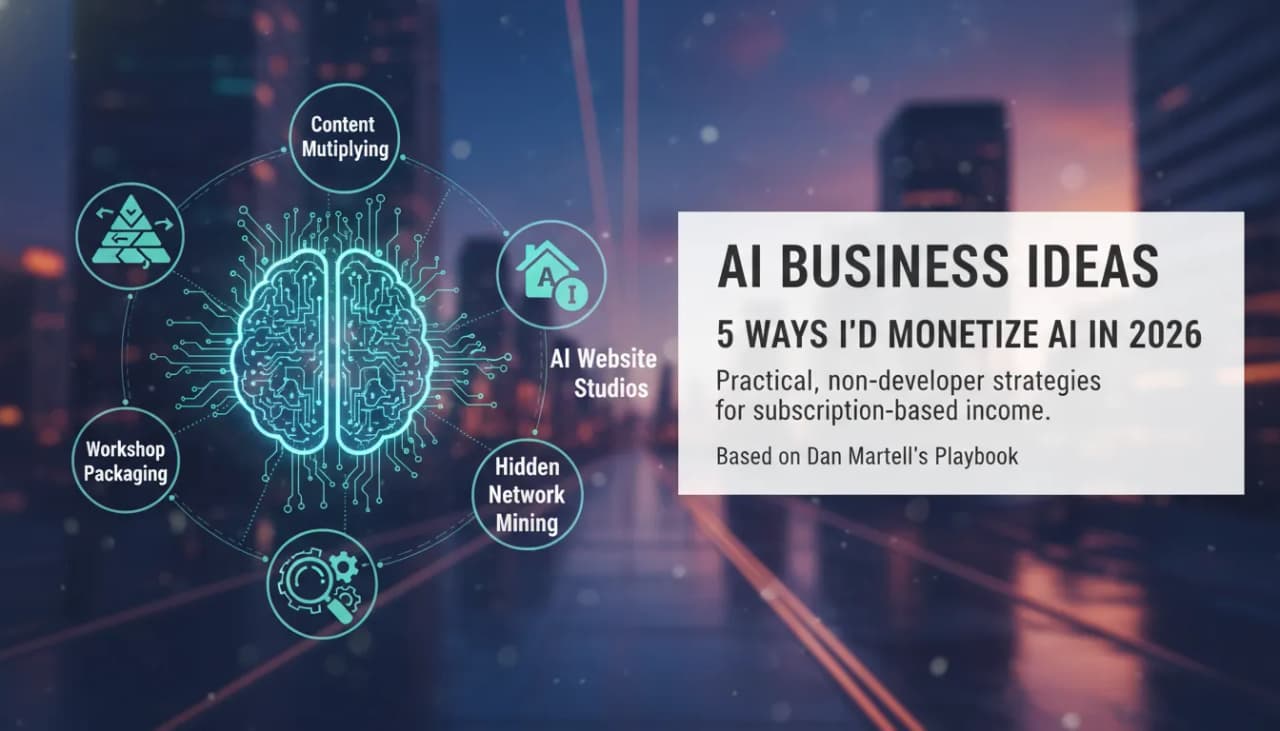
The first time I let an AI “fix” my work, it was a tiny thing: I’d mispronounced a word in a voiceover, and re-recording it would’ve meant booking studio time I didn’t have. A tool patched the line so cleanly I couldn’t hear the seam. That was my lightbulb moment: the AI tools that actually make money aren’t always the flashy ones—they’re the ones that quietly remove bottlenecks. So I took a YouTube tier list built from someone who claims to have tested 500+ tools (via Martell Ventures, an AI incubator) and re-framed it the way I’d explain it to a friend: which tools are “non‑negotiable,” which are sellable skills, and which are fun but flimsy.
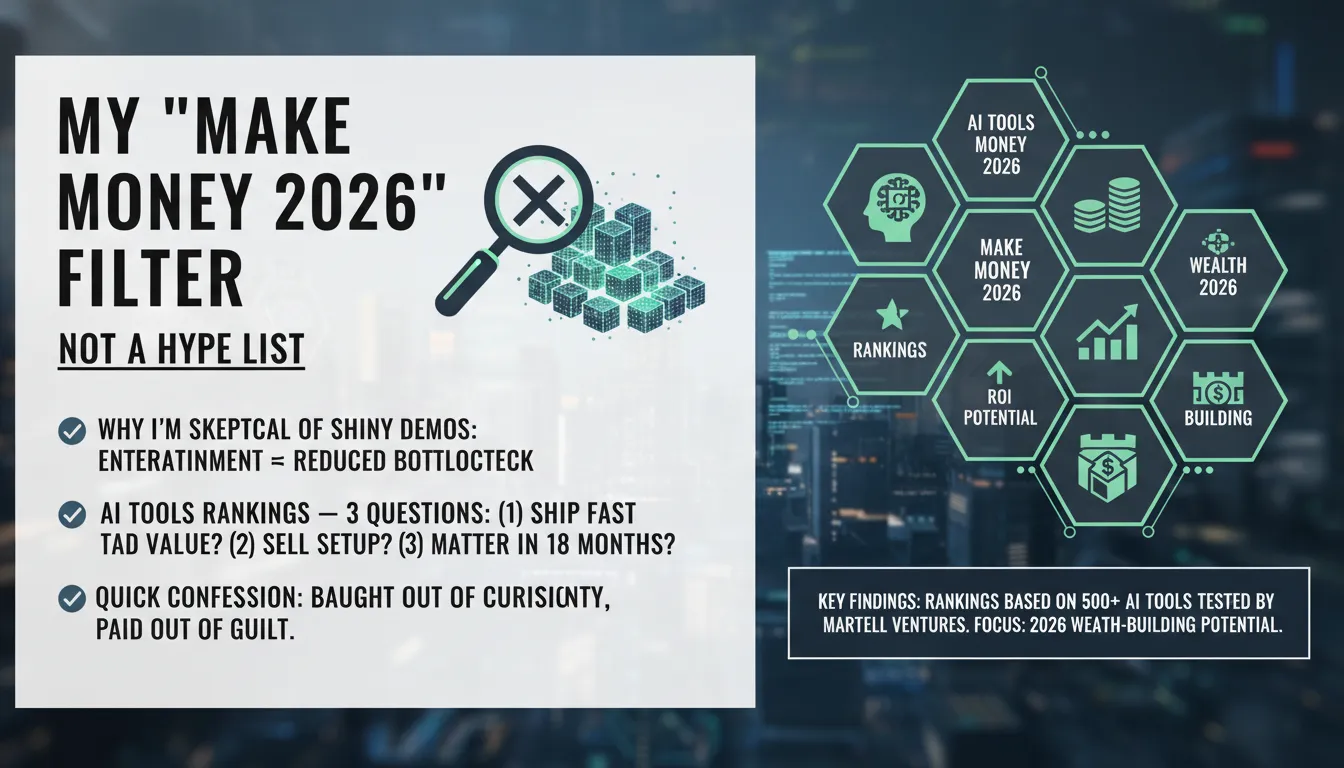
My “Make Money 2026” filter (not a hype list)
I like AI, but I’m skeptical of shiny demos. If a tool doesn’t remove a weekly bottleneck in my real workflow (client work, internal ops, or content), it’s entertainment—not Make Money 2026. My AI Tool Rankings are based on ROI Potential, not vibes.
I also lean on volume: at Martell Ventures (an AI incubator), we’ve tested 500+ AI tools to see which ones actually create value and support Wealth Building in 2026. That’s the lens I use for AI Tools 2026.
The 3 questions behind my AI Tool Rankings
Can it ship value fast? If I can’t get a win in days, it’s probably not a revenue tool.
Can I sell the setup? If I can package the workflow (templates, automations, prompts), it’s a business.
Will it still matter in 18 months? If it’s a feature waiting to be copied, I downgrade it.
Quick confession: I’ve bought tools “just to test”… then paid for them for three months out of guilt. That’s why I force this filter before I keep anything.
My wild-card test: 48-hour revenue recovery
If my laptop died and I had 48 hours to recover revenue, I’d reinstall automation + documentation first. If a tool doesn’t help me automate delivery or document repeatable work, it drops fast.
“We got the S tier, that's non-negotiable for the future.”
Data point | What it means |
|---|---|
Tools tested | 500+ (Martell Ventures) |
Goal year | 2026 |
Tiers | S (non-negotiable), A (widespread), B (niche), C (rare ROI), D (don’t bother) |
S Tier Tools: boring, foundational, and weirdly profitable
My S Tier Tools are not flashy. They’re the “operator” stack: the stuff that quietly drives ROI. In 2026, the top S Tier AI for making money still looks a lot like ChatGPT, Grok, Granola AI, Zapier, and the Gamma App—because they speed up output and tighten Business Automation.
Zapier Automation: the unsexy moneymaker
"I'm giving this S tier. This one is one that's foundation to any modern business."
I’ve used Zapier for close to a decade. It’s no-code, it’s been enterprise-ready forever, and it adopted AI fast. Agencies “print cash” with it because clients pay for outcomes, not tools.
Lead capture → CRM → Slack alerts (sales moves faster)
Invoice paid → onboarding email → task list (less admin time)
Granola AI notes: invisible until it’s missing
"I think everybody should use Granola."
Granola AI records on your end (not meant to be sneaky), creates recaps and action items, and works across all major video platforms. My favorite tools are the ones nobody notices—until the day they’re gone.
Operator anecdote: Granola notes saved me during a scope-creep argument. I didn’t “win” the argument, but I stopped losing hours because the recap showed what we actually agreed to.
Gamma App decks: the full-time designer vibe
"If you've never heard of it... I use it every week."
The Gamma App is my weekly shortcut for proposals, reports, and pitch decks. Ease-of-use is 9/10, and “prettier + clearer” client-facing docs close deals.
Proposal generator → client follow-up in one flow
Turn messy notes into a clean deck in minutes
A Tier AI: workflow builders and company “brains” that pay off (if you commit)
A Tier AI Automation Tools: Gumloop vs n8n (Workflow Builder face-off)
In my A Tier AI bucket, I’m looking for tools that can become real Business Automation infrastructure—not just a nice shortcut.
Gumloop is the one I reach for when I want speed and clarity.
"It's a visual AI workflow builder."
It competes with Zapier, but it feels more visual—almost like building with Lego. I’ve seen teams use it for financial automation and recruiting processes, and the UX is the reason it sticks. The tradeoff: if Zapier already covers your needs, Gumloop can be “extra.”
n8n is the opposite vibe: powerful, flexible, and sometimes like IKEA without instructions.
"What I love about it, it's open source."
Open source matters for security and ethics because the code base is auditable, and you’re not locked into licenses (it’s mostly server costs). The tradeoff is maintenance and a steeper learning curve, so it’s best if you’re technical or have a developer.
When A Tier makes sense
A Tier is worth it when you’re scaling a team, not just trying to save 20 minutes. These Workflow Builder setups pay off when they run every day and touch revenue, ops, or support.
BuddyPro.ai: the “company brain” internal help desk
BuddyPro.ai acts like a searchable AI brain trained on your company info. Done right, it cuts repeat questions and “where is that doc?” pings. The catch: it only works if you commit to training, permissions, and ongoing updates.
How I’d monetize this (quick hypothetical)
If I ran a 12-person agency, I’d productize automation + knowledge base as a monthly retainer: build workflows in Gumloop or n8n, then layer BuddyPro.ai on top for support and internal Q&A.
B Tier tools I’d sell as services (not staples): Midjourney, Runway, HeyGen, Leonardo
B Tier means I’d sell the output, not build my whole business on the tool. Reality check: clients don’t pay for Top AI Software names—they pay for brand assets, ads, and finished videos.
Midjourney (images you can productize)
Midjourney is prompt-to-image. It’s “Easy to use, super simple.” I’ve seen people sell brand packages, website mockups, and visual “Photoshop-type” work fast. The downside: you can do a lot of this in other tools, so defensibility is weak. I treat it as a service add-on, not a staple.
Runway ML (Video Content AI with a higher ceiling)
“Essentially, this is an AI powered video generating tool.”
Runway ML is my pick over images because video sells. Use it for marketing collateral, walkthroughs, and ad variations. But it can feel fiddly unless you’re in video all day. If you’re offering Midjourney Runway bundles, sell outcomes like “5 ad creatives + 2 landing hero clips,” not “Runway edits.”
HeyGen Videos (AI Avatar Videos for training + explainers)
HeyGen shines for AI Avatar Videos: training modules, product explainers, and internal updates. Ease-of-use is 8/10.
“It’s a fun tool but limited use depending on your business.”
Pricing story: I once quoted a fixed fee for 10 micro-training videos and learned scope boundaries the hard way—script length, revision rounds, and avatar changes must be written into the offer.
Leonardo.ai (concept art, but brand sameness is hard)
Leonardo is great for concept art and branded visuals, and designers love the styles. The risk is hallucinations and inconsistency, which can break “brand sameness.” I only sell it when the client wants exploration, not strict consistency.
C Tier: productivity sidekicks I won’t build a business around
In my AI Tools 2026 tier list, C-tier tools are the ones I’ll happily use as helpers—but I won’t base a Make Money plan on them. They can improve my day, yet their ROI Potential is limited because the value is mostly personal, not something I can package and sell.
Fixer.ai (C Tier): inbox sorting meets real-life habits
Fixer.ai is basically an email AI tool that categorizes and sorts messages. On paper, it’s a clever idea. In practice, it collides with how I already triage email—my labels, my rules, my “read later” pile. That makes setup and adoption harder than it looks.
"Clever idea. Super cool."
It will save me time, but I don’t see people paying me just to set it up. Email workflows are too personal, so the skill doesn’t transfer well from client to client.
Notion AI (C Tier, above Fixer): useful inside Notion, not a standalone offer
Notion AI is the built-in assistant for writing, notes, and organization. If I already live in Notion, it’s smooth and easy to use. But the AI feature alone isn’t a sellable deliverable.
"It's cool. It's still not where I need it to be."
People might pay me to set up a Notion workspace, templates, or dashboards—not “turn on the AI.” I also watch the competitive pressure from tools like OpenAI’s company knowledge layer, which could reduce Notion AI’s edge over time.
The quiet risk: time saved vs revenue created
Saves time doesn’t automatically mean creates income.
If it doesn’t build a transferable skill, I stop defending the subscription.
For research work, I’d rather lean on Perplexity AI (S-tier) for verified sources and fewer hallucinations.
Voice + Conversational AI: where I’m placing my 2026 bets
ElevenLabs Voice + Natural Language: the “pickup” trick that saves a studio day
ElevenLabs Voice is kind of the OG for realistic speech. It “Produces uber realistic AI voices.” My favorite use is simple: pickups. If I mispronounce a word (yes, “regularlessly” happened), my team can patch that one line without booking studio time. That saves hours, keeps the edit clean, and lets us ship more creative faster. It’s fantastic for content creators and teams doing lots of voiceovers—maybe not essential for every business, but it’s right on the edge.
YourAtlas as an AI Sales Assistant: calls still move money
For Conversational AI that touches revenue, I’m betting on phone automation. We use YourAtlas (youratlas.com) for outbound qualifying and inbound responses. As an AI Sales Assistant, it’s practical because most businesses still live and die by calls: leads, follow-ups, scheduling, and reactivation. The learning curve is mostly basic prompt engineering, and people are already getting paid to set it up for companies.
“I think every interface in the future will go away and it'll all be voice.”
Bias + ethics: my disclosure and a quick responsible-use checklist
Full transparency: YourAtlas is in my portfolio. I treat that as a bias risk, not a reason to dismiss it—so I judge it by adoption, outcomes, and whether it works in real workflows. Also, voice needs guardrails:
Consent for any cloned voice
Disclosure in ads/customer calls when required
Brand guidelines (tone, do-not-say list, escalation rules)
Side note: I’m watching Grok too—praised for accuracy, depth of research, and weekly improvements—which matters as these agents get more “Natural Language” and less scripted.
Conclusion: My 2026 stack is less ‘AI’ and more ‘leverage’
That voiceover “pickup” moment from the intro still holds up: the Best AI Tools aren’t magic, they’re multipliers. In my AI Tool Rankings for AI Tools 2026, the pattern I can’t unsee is simple—tools that document, automate, and standardize wins keep paying you back. Tools that only “create” are often the easiest to replace, because everyone can prompt.
ChatGPT is the default layer (and the elephant in the room)
"Did you know close to 700 million people use [ChatGPT] every week?"
It’s been about 2.5 years since launch, and that scale tells me ChatGPT is the baseline for most workflows. I use it constantly, but I try not to pretend it guarantees Wealth Building by itself. Money usually shows up when friction is removed and the process repeats.
If I’m overwhelmed, this is my starter stack
If I had to restart today, I’d begin with Zapier + Granola.ai + Gamma.app. Zapier handles automation, Granola captures and cleans up meetings and decisions, and Gamma turns rough thinking into clear decks and docs fast. Then I’d add one specialty tool based on my work—video, voice, or a knowledge base. For higher ROI automation, I’m still testing where Grok fits best, so I’m cautious about promising results.
My wild card analogy: AI tools are like kitchen knives—owning 12 doesn’t make dinner happen; having one sharp chef’s knife does.
Gentle dare: pick one workflow to automate this week and measure time saved like it’s revenue—because it is.
